About the Series and the Artist
Almost thirty years ago, I was convicted of a crime that still defines who I am to people who don’t know me. Three decades later, with no similar convictions since, who I was that long time ago is how I’m seen by the legal system, by government, and by those who don’t take the time to see me—who look at me through the lens of who I might have been so long ago.
Twenty-seven years later, three years ago, I was arrested for failing to provide a phone number to a police officer. On September 2, 2025, I returned to Rhode Island, leaving my husband, my dogs, and my home behind to clear up that three-year-old case. I was sentenced to probation and, per Federal law, qualified for a mandatory five-day transfer of that probation from my former home of Rhode Island to my new life in Western Pennsylvania.
More than a month into that supposed “five-day wait,” I have been forced into homelessness in Rhode Island, waiting for bureaucratic red tape and game playing that seems Kafkaesque to me. My husband struggles to manage at home through a serious diagnosis without me. I am penniless, food-insecure, roaming the streets of Providence as I wait for the powers that be to finally follow the laws they like so much to enforce but not follow themselves.
Out of this ordeal, these photographs come. These images were captured on a cell phone provided by Better Lives RI, a Providence organization supporting people experiencing homelessness. I own nothing—not the phone recording my erasure, not the roof over my head, not even the certainty of tomorrow. But I can still see. I can still create.
My work investigates memory as an unstable medium—something that happens to us as much as something we control. Working primarily in digital photography, I’m drawn to water’s surface as both subject and metaphor. Water never returns an exact reflection; it ripples, distorts, and reconstitutes what hovers above it. These photographs explore the gap between official memory and lived experience, between the narratives we’re told and the truths water reflects back to us.
As a justice-impacted queer artist separated from my husband and home by a system that sees only who I was thirty years ago, I understand intimately how identity gets shaped by forces designed to control rather than nurture. Through water’s transformative lens, I examine questions of agency: Who decides when we remember? What does it mean when the state can look at you and see only your past? How do we create beauty and meaning from circumstances we didn’t choose, while waiting for bureaucracy to grant us permission to return to our lives?
This site now documents two separate ordeals—Chapter 1 - September through October 2025, and Chapter 2 - February through March 2026. The system did not learn. Chapter 3 has not been ruled out.
What the River Remembers
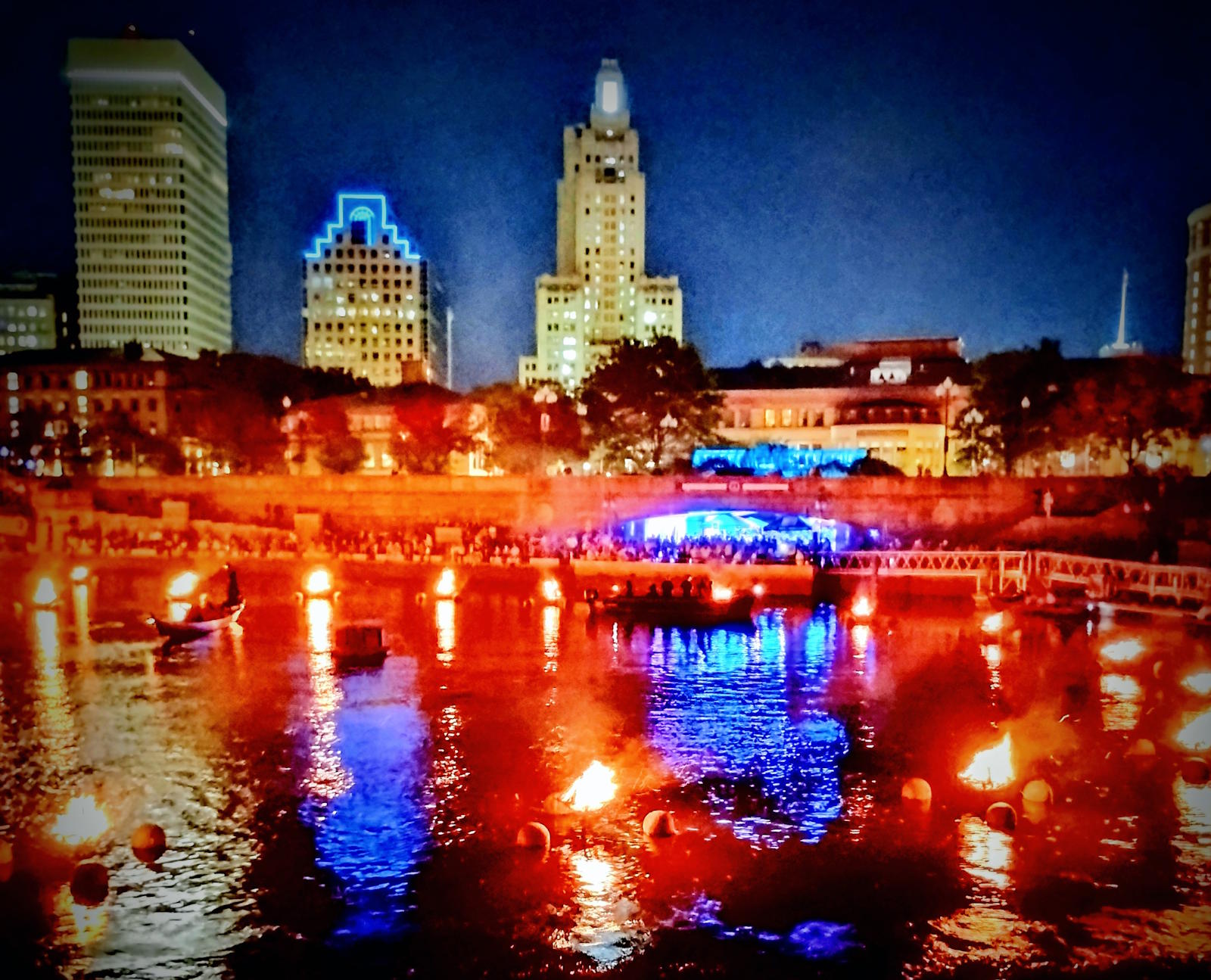
On September 27, 2025—twenty-five days into what Federal law mandates should be a five-day probation transfer—I am still trapped in Providence. Homeless. Separated from my husband who is managing a serious diagnosis alone. Penniless and food-insecure. Routinely harassed and looked down upon for my homelessness and my sexuality.
That evening, I happen upon WaterFire, Providence’s ritual of flame on water—a celebration of community and renewal. I stand at the river’s edge with nowhere to go, watching my former city burn beautiful in reflection. Thousands celebrate around me. I am invisible: defined by a decades-old conviction, arrested three years ago for not providing a phone number, now homeless because bureaucracy won’t follow its own laws.
I choose to make art.
This photograph is an act of defiance disguised as beauty. When systems work to erase you—when they can look at you and see only who you were three decades ago, when they trap you in legal limbo while your husband suffers without you—the most radical thing you can do is insist you still see, still create, still matter.
The city burns in reflection while remaining stable above, suggesting the disconnect between official reality and lived experience. The system says: five days. Reality says: almost a month homeless, waiting. The system says: who you were thirty years ago. I say: look at what I create today.
The heroic isn’t always triumphant. Sometimes it’s standing at water’s edge, invisible to the celebrating crowd, separated from everyone you love by Kafkaesque bureaucracy, and choosing to create beauty anyway.
Cliffs of Memory
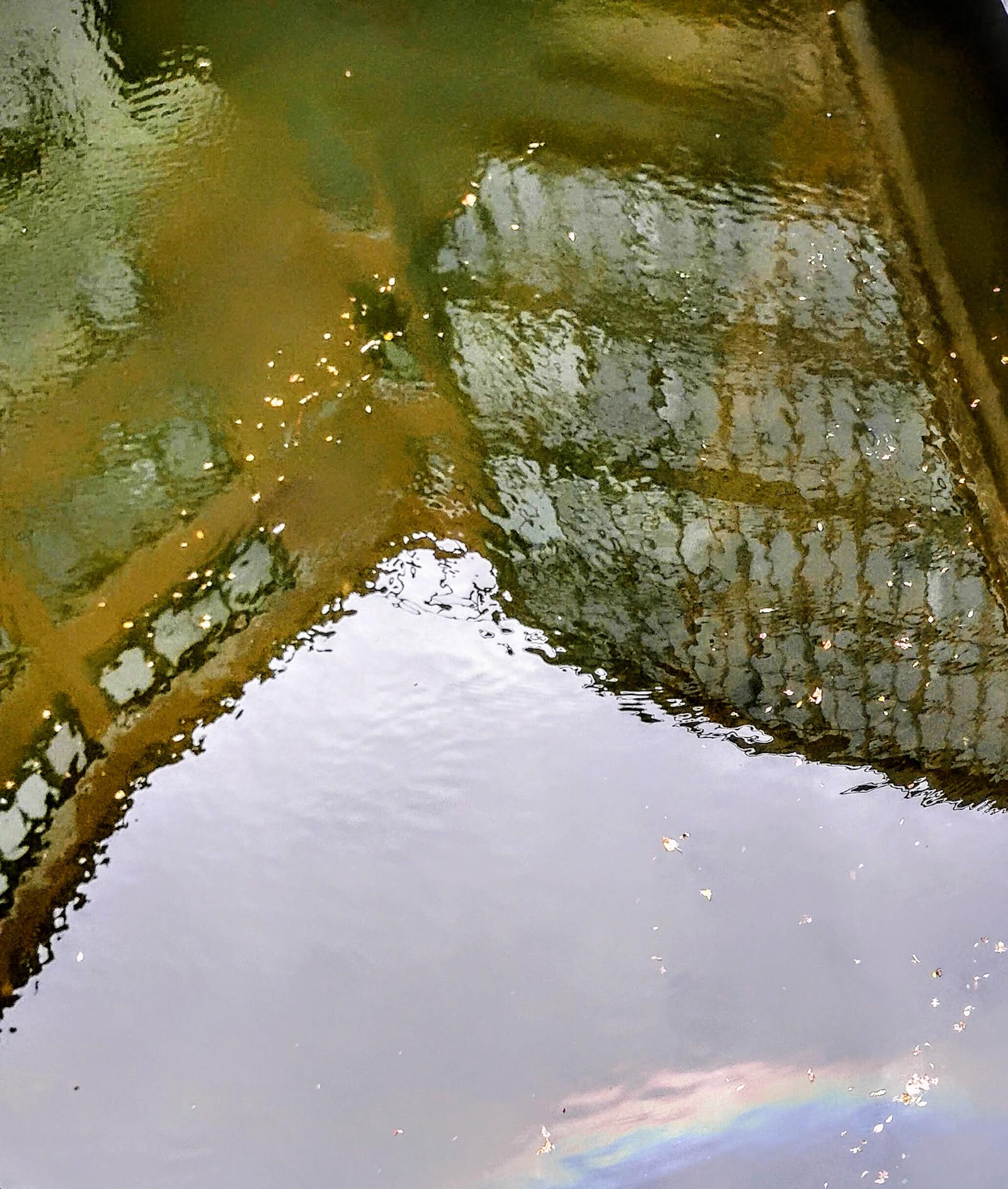
Two days later, I am still wandering Providence’s rivers, still trapped in the bureaucratic limbo that turns five days into weeks.
“Cliffs of Memory” captures the Providence Place Mall reflected in water—consumer architecture transformed into something almost geological, monumental buildings dissolved into abstraction. The cruel irony: I am homeless, photographing a shopping mall’s reflection. I can’t afford what is sold inside those walls. I can’t even afford food. But I can transform the building into art.
These structures—symbols of commerce, prosperity, belonging—exist for me only as reflections, distorted and inaccessible. The justice system remembers who I was thirty years ago with perfect clarity. It forgets to look at who I have been for the three decades since. It forgets Federal law says five days. It forgets I have a husband at home facing medical challenges without me.
What the system calls “cliffs” are actually temporary commercial, legal, and financial structures. What it treats as permanent—my identity as someone who committed a crime three decades ago—should have dissolved long ago. Yet here I am, trapped by institutional memory that refuses to see present reality.
Through water’s transformative surface, spaces that exclude me become material for creation. That day, the Providence River gives me what the building, the system, and the city itself can’t: something beautiful that is mine.
This is what resistance looks like: choosing to create when you have nothing, to see beauty in spaces that exclude you, to insist on artistic vision when you’re invisible to everyone inside those reflected walls.
Self-Portrait, Waiting
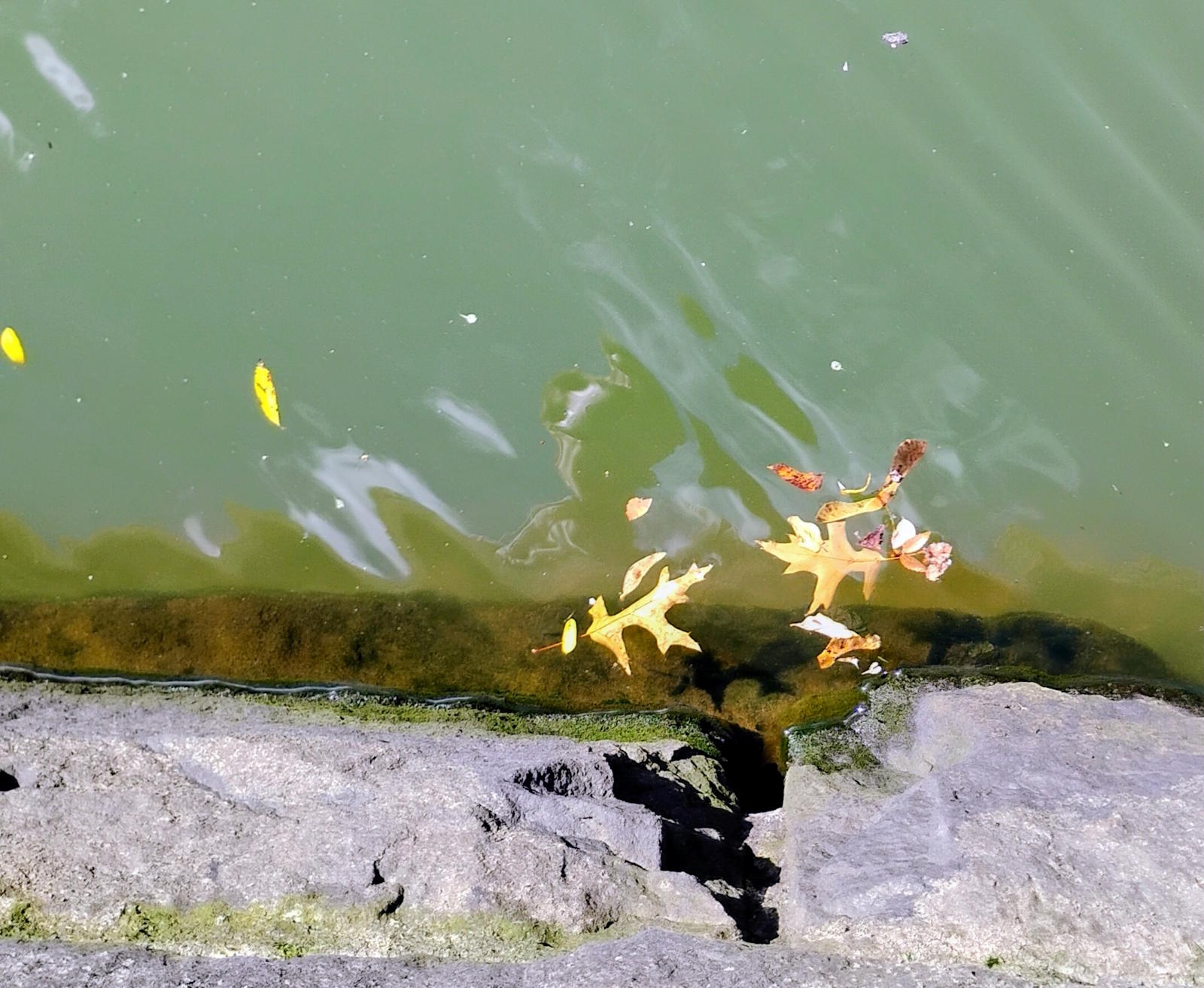
On October 1, 2025, I lay down on the concrete wall at Memorial Park and point my camera straight down into the Providence River. My reflection appears barely visible in the green water, fractured by ripples, surrounded by oak leaves drifting past on currents I can’t control.
This is what it looks like to be suspended. To exist as reflection rather than substance. To be dissolved into the system’s waters alongside autumn debris—both of us subject to forces beyond our agency, both falling, both drifting, both barely there.
The concrete wall beneath me: institutional infrastructure, the permanent weight of systems built to contain and control. The water: holding my image but refusing to preserve it, transforming me into something unrecognizable, barely present.
I take this photograph twenty-nine days into what Federal law mandates should be a five-day probation transfer. Still homeless, still separated from my husband managing serious illness in Pennsylvania, still penniless and food-insecure, still waiting for bureaucracy to follow its own laws.
The oak leaves—autumn gold, falling, ending their cycle—become my companions in the frame. We are both where we didn’t choose to be, both drifting, both subject to seasonal forces (theirs natural, mine bureaucratic) that determine our paths without our consent.
This is a self-portrait of invisibility. The justice system looks at me and sees only a decades-old conviction, a case file, someone to be processed and delayed. In the water, I’m equally insubstantial—a ghost among leaves, barely distinguishable from the debris. But I’m there. Fractured, distorted, vulnerable, but present. Still seeing. Still creating.
The irony of location: Memorial Park, built for remembering. But whose memory? The river holds everything else—the homeless, the waiting, the invisible, those of us trapped between who we were and who we’re allowed to become.
To create this image, I have to make myself vulnerable—lying flat on concrete, reaching down toward water, putting my body at the edge. This is the posture mandatory waiting requires: prone, reaching, hoping the system might finally see you as you are rather than as it remembers you.
Water transforms everything it touches. In this reflection, I’m transformed too—made uncertain, made ghostly, made almost invisible. But the photograph proves I exist. However fragmented, however distorted by systems that refuse to see who I’ve become, I remain. Creating. Witnessing. Waiting.
Shadow of a Shadow
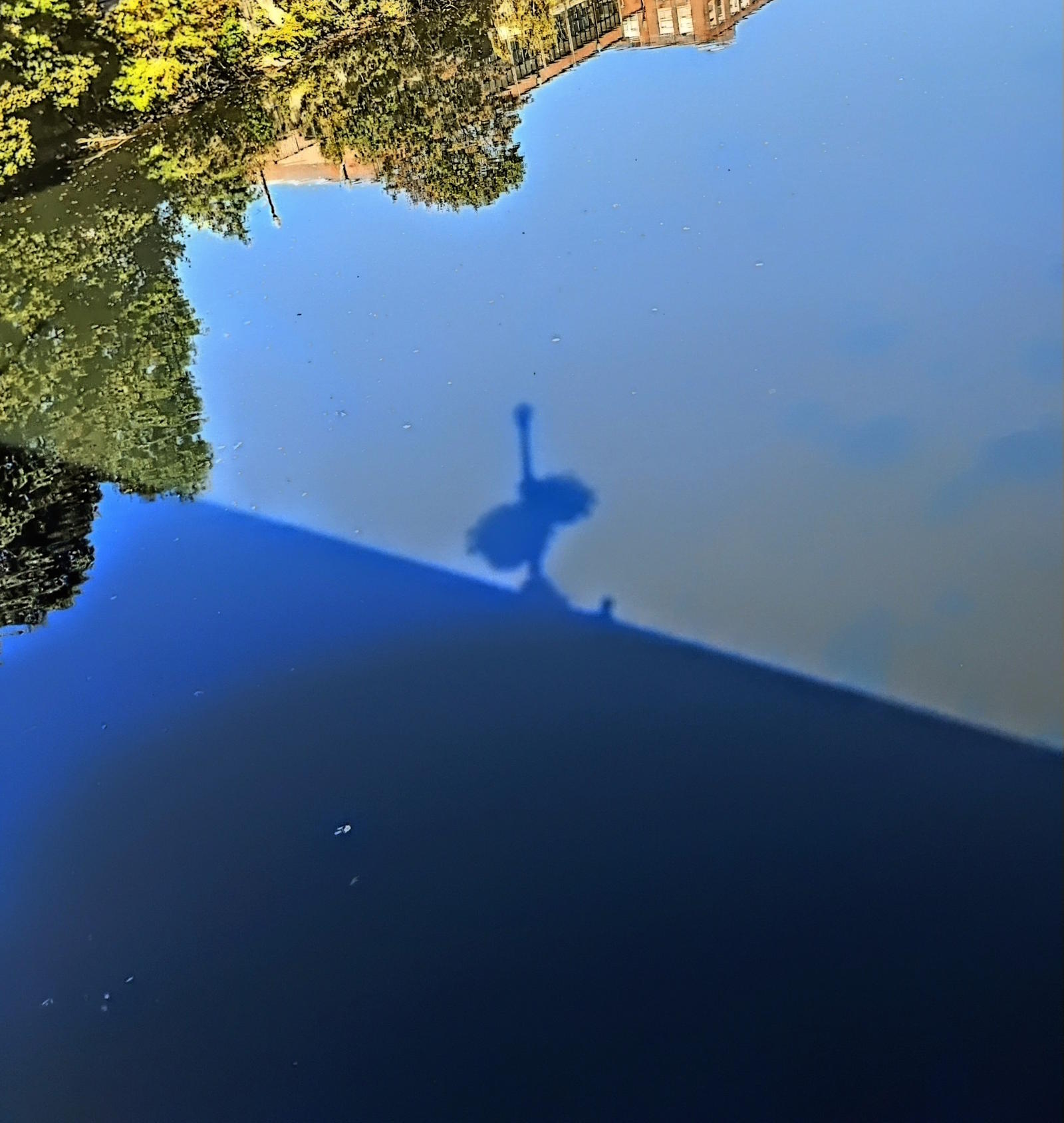
I stand on the Exchange Street bridge in Pawtucket, looking down at the Blackstone River below. The water holds only shadows now. Not even my reflection—just the shadow of my reflection. The bridge’s shadow. The shadow of hanging plants. And somewhere in that darkness: the shadow of my head, my hand holding a borrowed phone, my camera.
This is what prolonged erasure looks like. I’m not even substantial enough to be a ghost in the water anymore. I’ve been reduced to the shadow of a shadow—twice removed from presence, from substance, from being seen.
Around me: Pawtucket Veterans Memorial, Pawtucket City Hall, the Pawtucket Housing Authority, the Pawtucket Armory Arts Center. Institutional architecture, civic infrastructure, structures built to serve and house and honor people. I wander among them, unseen—a shadow passing across a bridge, too insubstantial even to cast my own image in water.
I take this photograph thirty-three days into what should have been five. I spend my days wandering, crossing bridges, following rivers, documenting my own disappearance with a borrowed phone. Each night, I return to a homeless shelter—a bed, a temporary roof, the minimum infrastructure of survival that the state’s failure made necessary.
When you’re trapped long enough in bureaucratic limbo, you don’t just become invisible. You become less than invisible. You become the memory of a reflection of someone who once cast light. You become what water forgets even as it’s forgetting.
But the photograph exists. However faint, however abstracted, however reduced to shadow and outline—I was there. I am here. Still making art from absence. Still creating evidence of existence from the very tools of my erasure.
Standing on that bridge, looking down at my own near-disappearance, and choosing to document it rather than surrender to it.
Shadow on the Other Bank
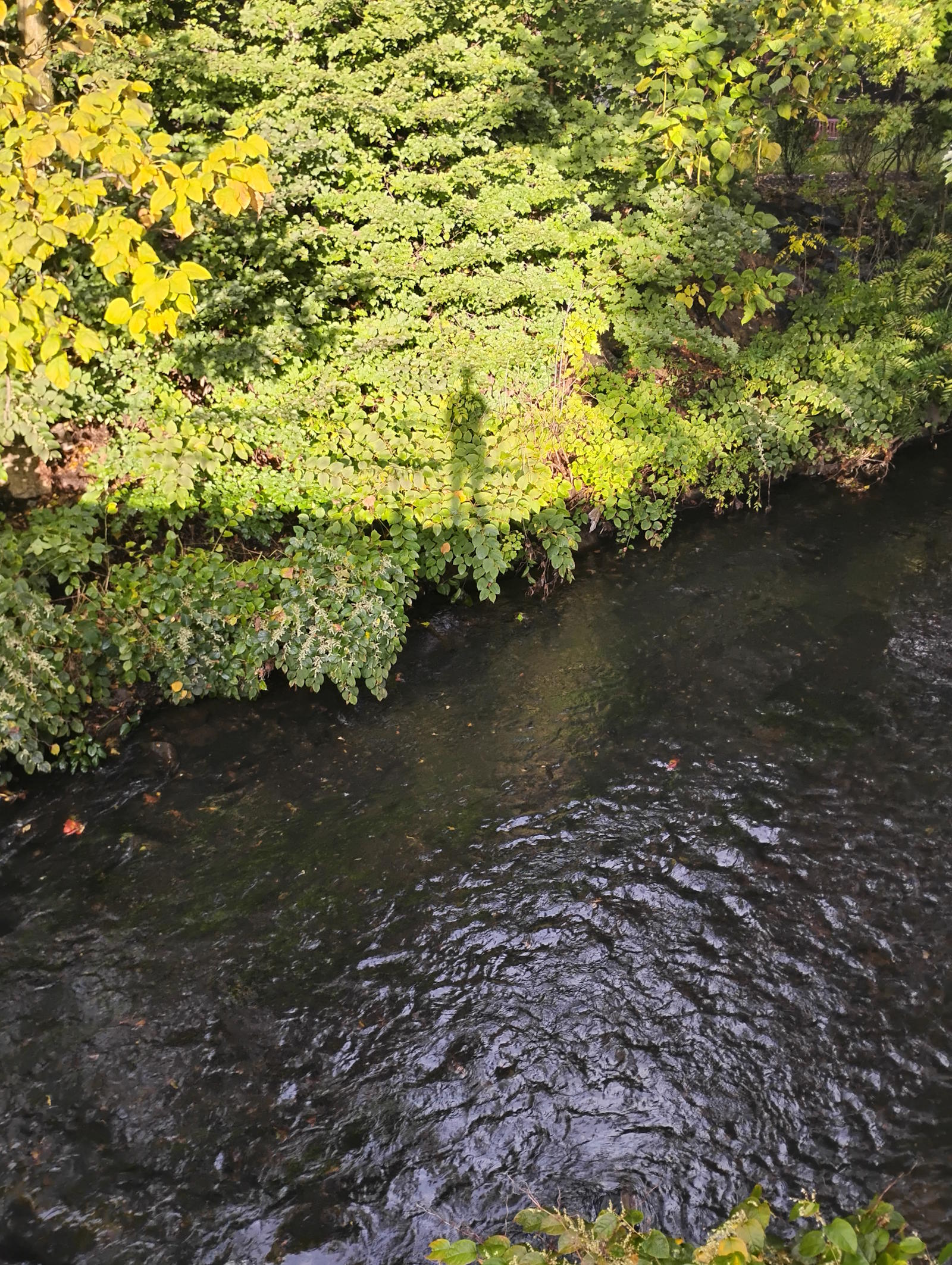
On the morning of October 15, 2025—forty-three days into what Federal law mandates should be five—I walk from the Open Doors RI homeless shelter toward the Providence County Courthouse to collect paperwork authorizing my temporary return home to Pennsylvania, to my husband, to my dogs, to the life bureaucracy held hostage for six weeks.
I cross a small bridge on Randall Street over the Moshassuck River and pause. The sun behind me casts my shadow forward onto the leaves hanging over the water—still green, resisting autumn. For the first time in this ordeal, I am not a reflection—fractured, distorted, barely visible in water that refuses to hold my image. I am solid. Present. Projecting forward.
My shadow reaches across the river toward the other bank. It almost looks like I’m standing there already—my shadow-self waiting on the far shore while my physical body remains here, still in Providence, still homeless for one more night, still walking to collect papers that grant only temporary reprieve.
This is not the water’s memory anymore. This is mine. After forty-three days of documenting my own erasure, I photograph my re-emergence—not as reflection, but as projection. Not asking water to remember me, but casting my own image forward toward home.
This slight victory happened because one person in the system chose to see me as human. Ingrid Siliezar, Rhode Island’s Deputy Compact Administrator, took the time over the course of this ordeal to actually know me. She did what no one else involved in this process cared to do: she looked at who I am today, not just who I was thirty years ago.
But here’s the problem: it shouldn’t depend on luck. Justice shouldn’t require that you happen to get the one administrator who chooses humanity over protocol. The system should guarantee what Ingrid Siliezar chose to provide—but it doesn’t. Federal law says five days, yet I spent six weeks homeless because the system makes compassion optional and accountability absent.
I got lucky. Thousands of others don’t.
The shadow reaches across water but doesn’t touch it. After six weeks of water failing to hold my image—of reflections that fractured and faded, of becoming a shadow of a shadow—now I cast my presence onto living things. The water below couldn’t hold me. The living world above can.
Tomorrow morning I will board the 6:50 AM Amtrak train from Providence Station. Providence to Philadelphia to Johnstown. Crossing rivers, crossing state lines, crossing back into the life that should never have been taken from me. The shadow on the leaves will remain in Providence. The person who cast it goes home.
Temporary.
What Water Remembers — Temporary
Five photographs documenting September – October, 2025
Weeks that should have been five days.
The system remains broken.
Still Here. Still Waiting.
Four months after going home, I came back. Not because I wanted to. Because the system that failed me the first time had never been held accountable—and so it simply did it again. And this time, a blizzard came too.
On February 12, 2026, I returned to Rhode Island for a court hearing on a motion to vacate my sentence entirely. This was not a routine appearance. My appellate attorney had argued that the sentence should never have been imposed. Rhode Island’s Deputy Compact Administrator and the supervising officer responsible for my probation had gone so far as to advocate directly to the court for full vacatur—not a transfer, not a modification, but the recognition that this sentence should not exist. I had a flight home to Pennsylvania booked for the following morning, February 13th. I expected, that night, to be done with Providence’s streets and shelters forever.
The motion was not granted. And Pennsylvania—which under federal interstate compact law had been required to formally accept or deny my probation transfer within five days of my original sentencing, and had never done so—still had not acted. Months later. Still nothing. The 45-day investigation clock started again, for the second time, in the same city, on the same streets.
This is the nature of the system. It does not say no. It never says no. It processes. It refers. It defers. It generates windows that become extended timelines that become formal complaints that become new windows. Franz Kafka imagined a bureaucracy that kept its supplicants suspended indefinitely in the act of waiting—never refused, never admitted, endlessly processed. He called it The Castle. I call it the Pennsylvania Interstate Compact Office and the Commonwealth’s probation system, which has now been the subject of a formal Rule 6 complaint filed by Rhode Island’s Interstate Compact Office with the National ICAOS office for its systematic and deliberate failure to follow the federal rules that exist precisely to prevent what I am living through. A compliance crime in its own right, committed by the state that endlessly processes me for being accused of one.
Same streets. Same shelter system. The same Kennedy Plaza where I had stood before. In the weeks since, I have been near two stabbings—one at a soup kitchen, one at Kennedy Plaza. I watched a woman attempt to set Kennedy Plaza on fire. I have been accosted on a bus, harassed at the shelter. I routinely eat dinner from the back of a church van in the rain or snow. And on February 24th, a historic blizzard buried Providence while I was homeless in it—unable to reach shelter, stranded at Kennedy Plaza as the city shut down around me.
A development that arrived the same morning I did: On February 12, 2026—the same day I traveled to Rhode Island for my hearing—Associate Justice Kristen E. Rodgers of the Rhode Island Superior Court dismissed a criminal information in State of Rhode Island v. Cristian Garcia (No. W2-2025-0156A). The charge: failing to notify police of a change in telephone number. Justice Rodgers held that under R.I. Gen. Laws § 11-37.1-10(a), criminal penalties are strictly limited to failure to register, failure to verify an address, and failure to give notice of a change of address. Telephone number is not listed. The court concluded: “a criminal penalty cannot be read to include conduct that the General Assembly did not expressly proscribe.”
My conviction is for exactly this conduct. Not a variation. The identical statutory omission. Two other similar cases have since been dismissed by Superior Court judges on the same grounds. A third case—ahead of mine in the Rhode Island Supreme Court—is expected to result in a ruling that will likely reverse convictions like mine entirely.
On the morning of February 12, 2026, while I was traveling to Rhode Island to fight for my freedom, a judge in Washington County ruled that what I was convicted of was never legally a crime, while a judge in Providence County declined to vacate the sentence. Twelve days later, I was stranded in a historic blizzard, homeless, unable to reach shelter—for that.
In October 2025 I walked away from water toward home. In February 2026 the system walked me back. I still have my phone. I can still see. I am still here. These photographs are Still.
Burnside Park, February 19
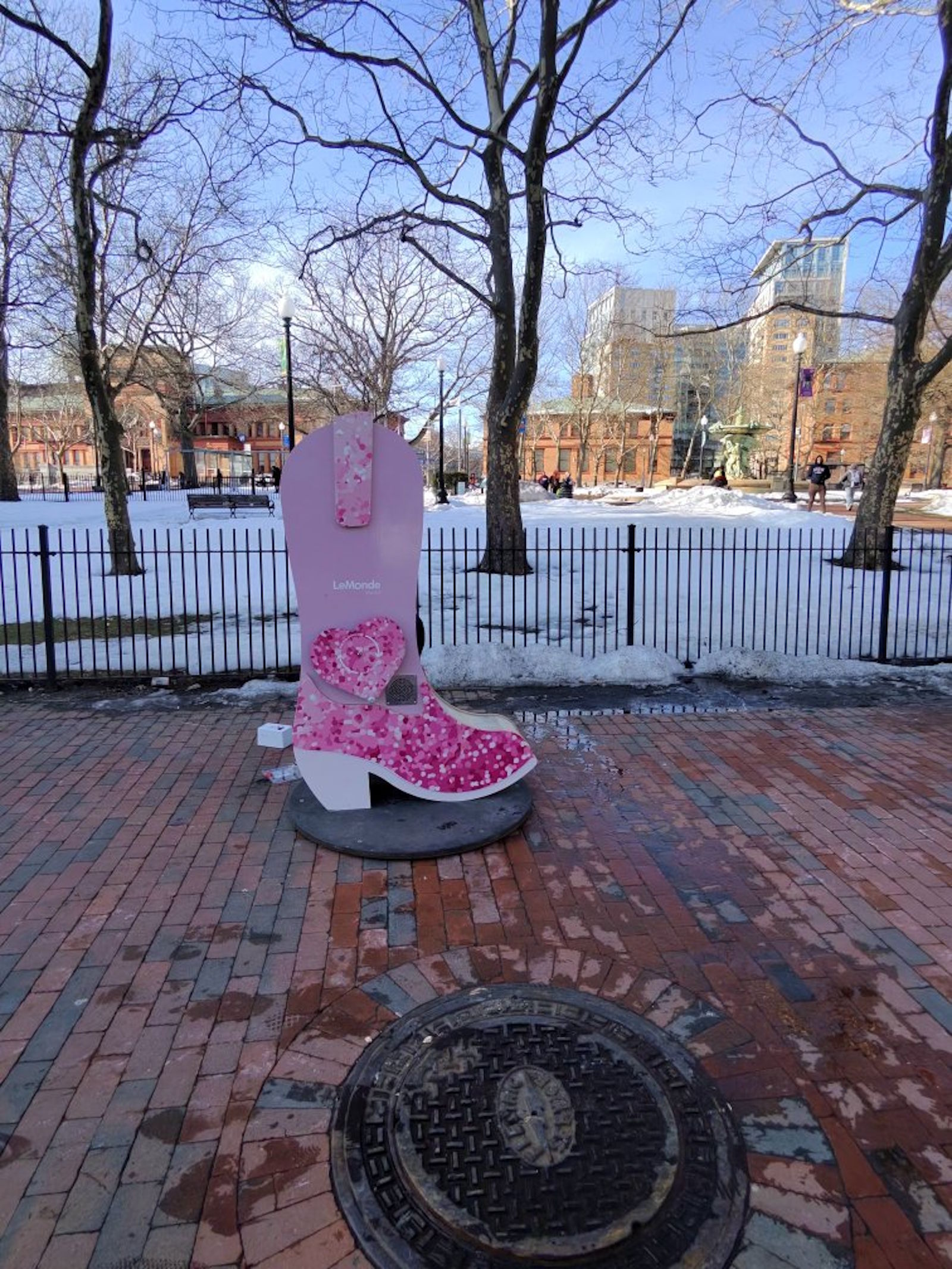
Seven days into my second stay in Providence, I walk through Burnside Park and find this: a large pink cowboy boot, part of a public art installation, standing in the snow. Cheerful. Festive. Decorated with hearts.
Behind it, bare winter trees. Snow on the ground. The city going about its business. People in coats, heads down, moving through the cold.
I am homeless, seven days into what should have been five. I passed through this park during my first ordeal too, in the autumn, among the leaves. The park was different then—warm, green, populated with people sitting on benches. Now it is cold and empty and I am still here, again, watching Providence display cheerful public art for residents who get to go home afterward.
The boot says nothing about me. It is not for me. It is civic decoration, a gesture of whimsy for a city I cannot afford to leave. I photograph it because it is exactly the kind of thing you notice when you have nowhere to go and too much time to look. You notice what the city performs for people who belong to it.
I am not performing belonging. I am documenting its absence.
Five days from now, the blizzard will come.
Do Not Enter — Washington Street & Kennedy Plaza, February 24
February 24, 2026. The historic blizzard of 2026 buries Providence. I am homeless in it. I cannot reach the shelter. I am stranded at Kennedy Plaza as the city shuts down—for a conviction a Superior Court judge ruled, twelve days ago, was never legally a crime.
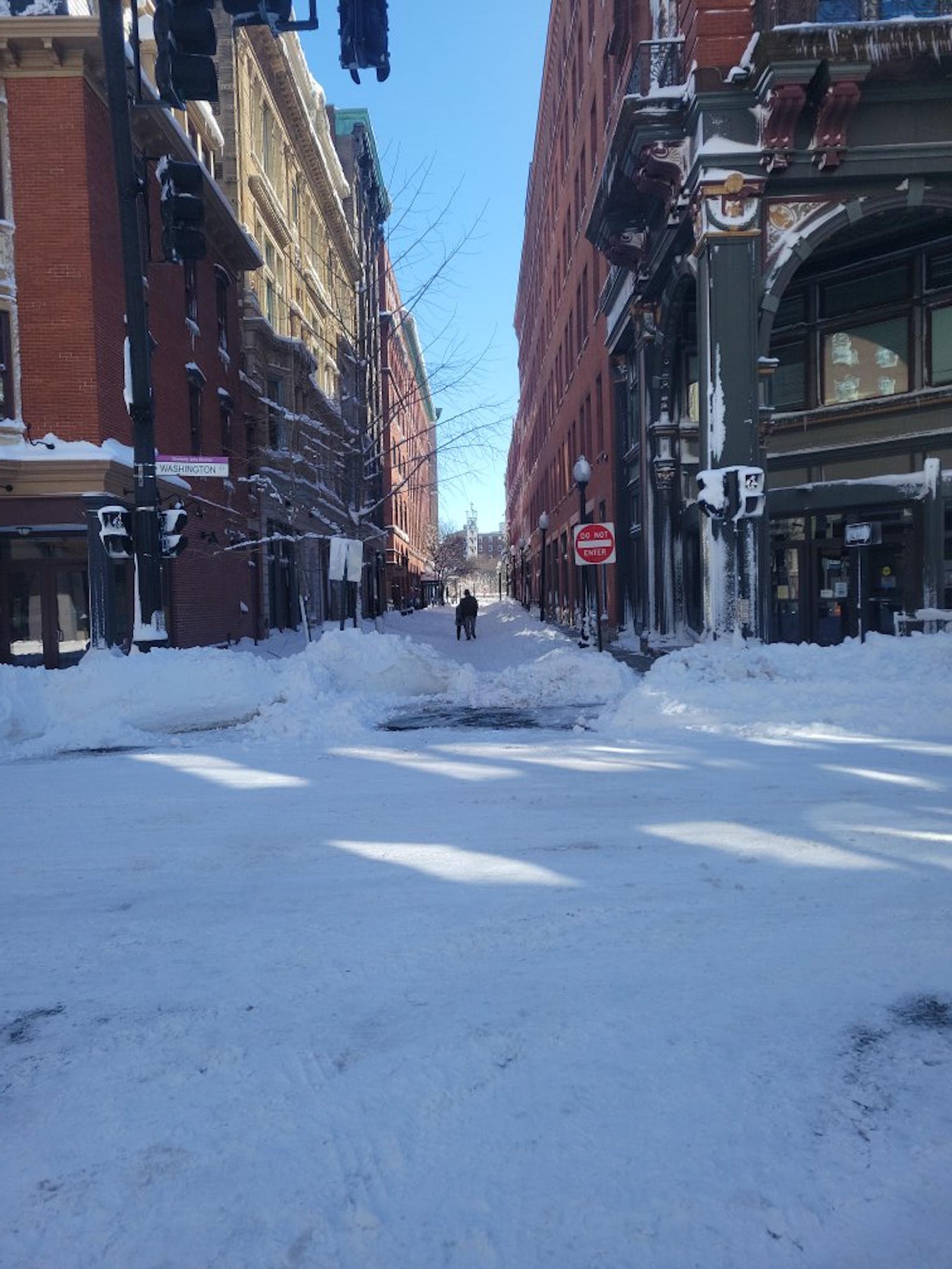
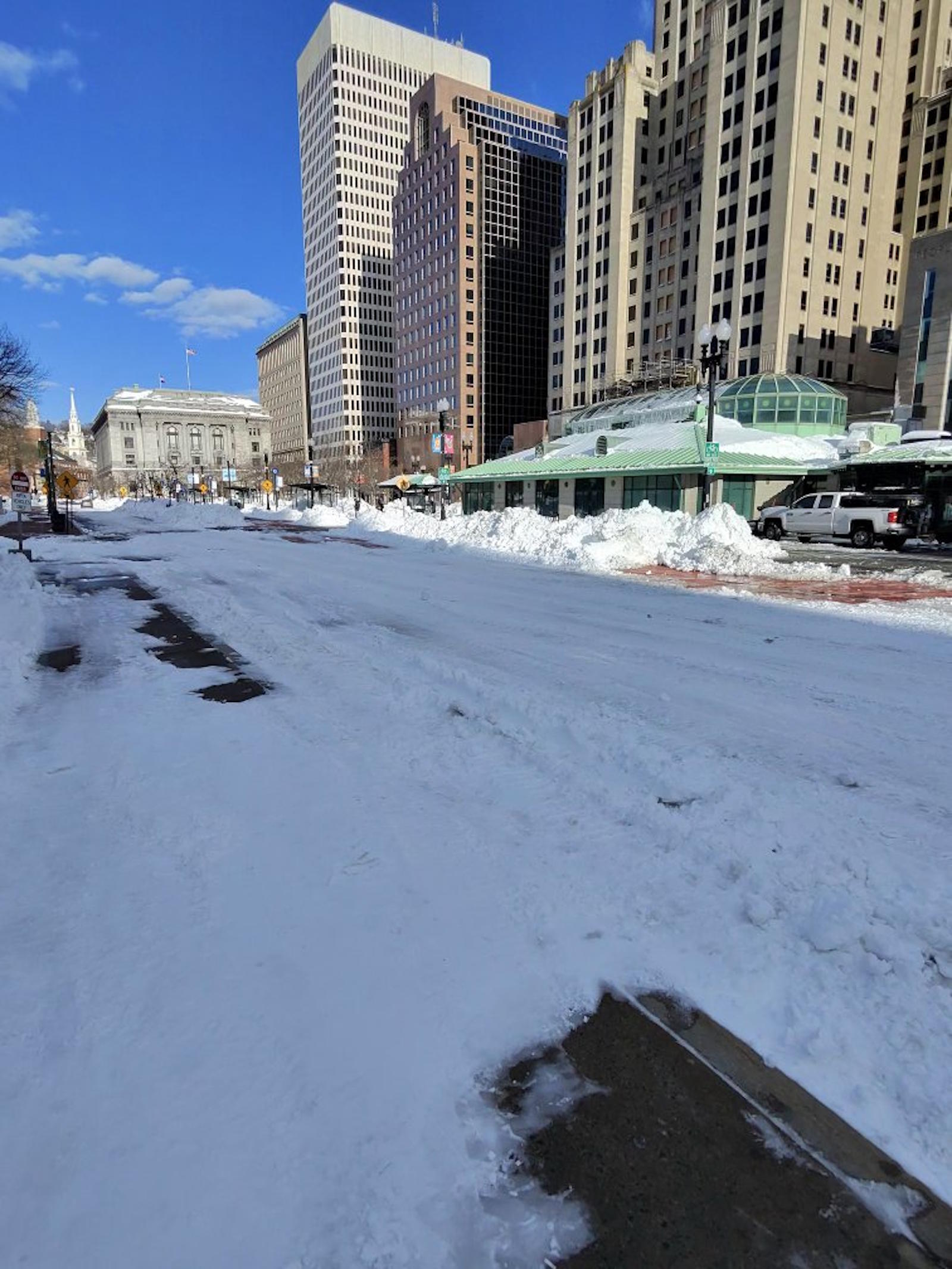
Washington Street, February 24, 2026. The historic blizzard has stopped the city. Cars are buried. Streets are impassable. Two figures walk through the only navigable path—a narrow channel cut through snow that towers on both sides. On the right: a red and white sign. Do Not Enter.
I did not plan this photograph. I did not seek out that sign. I was walking because I had nowhere to stop. I was photographing because it was the only thing I had left to do.
But there it is. Do Not Enter. The city says it to me in its official signage, its shelter waitlists, its locked doors, its system that has had months to send me home and has not. The shelter I was trying to reach was inaccessible. The buses had stopped. Kennedy Plaza—where I had spent weeks waiting, the plaza of the vans and the stabbings and the fire—was where I sheltered as best I could as a historic blizzard buried the city around me.
The second photograph is Kennedy Plaza itself: the familiar bus station dome, the skyscrapers I have looked at for weeks, the brick plaza I know the way you know a place you cannot leave. Everything is white. Everything has stopped. The city is frozen and I am in it, homeless, in a blizzard, for a crime that a judge said twelve days ago was never a crime at all.
In Chapter One, I stood at the WaterFire basin and watched fire burn on water. Thousands celebrated. I was invisible.
In this chapter, I stand in the aftermath of a historic blizzard at the place the city has told me, again and again, that I cannot leave—and the sign says exactly what the system has been saying for months.
I choose, again, to make art.
The Corridor — Westminster Street, February 24
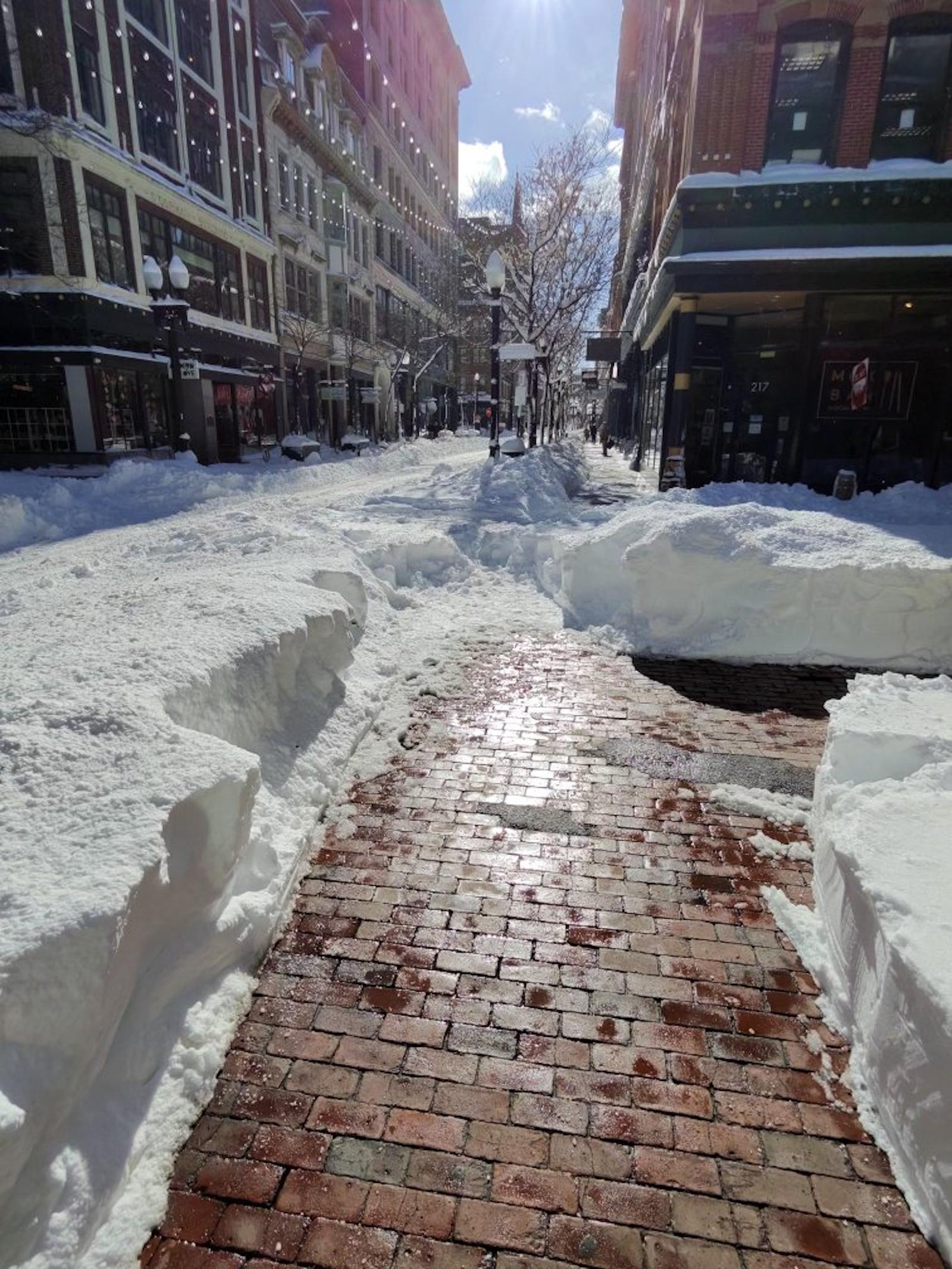
Westminster Street, hours after the blizzard. A narrow path of wet red brick runs between walls of snow that tower above head height on both sides. Christmas lights still hang on the building to the left, incongruous. The path leads forward toward the city, toward whatever is down there, toward somewhere that is not here.
In the first chapter, I photographed the Providence Place Mall reflected in water—commerce as cliff face, belonging visible but inaccessible. This is the same city from the inside of its emergency. The corridor it cuts through the snow is not invitation. It is minimum passage. It is the width of a person trying to get through.
I think of all the things that have been reduced to corridors in this ordeal: the five-day window that became six weeks, then forty-five more days. The legal process that should have sent me home and instead kept me in a passage with no exit. The shelter beds that are always almost full. The narrow channel between where I am and where I need to be.
The brick is wet and reflective. After weeks of looking for water to photograph my reflection in—rivers, puddles, still pools—I find it here, in the wet surface of Westminster Street after a blizzard, in the narrow path the city has left for people who have to be outside in it.
I am walking this corridor. I have been walking corridors for weeks. The snow does not know that. The brick does not know that. The water reflecting the winter sky in the wet pavement does not know that. But it shows me exactly where I am.
Welcome — Kennedy Plaza Terminal, March 17
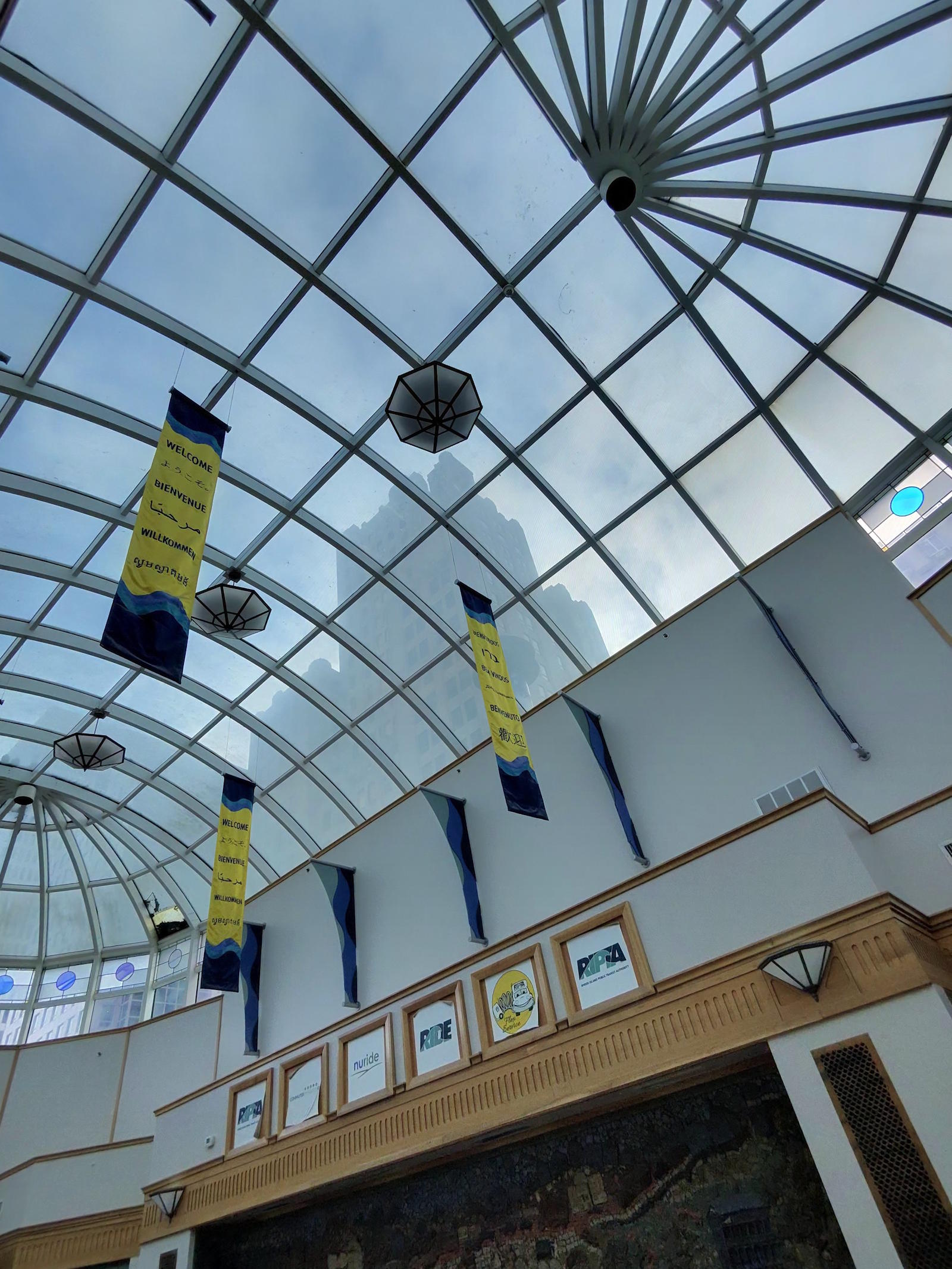
March 17, 2026. Thirty-three days in. I am at Kennedy Plaza—the bus terminal, the place I have spent weeks waiting, the place of the van and the stabbings and the fire and the blizzard. The glass ceiling of the terminal opens to a pale sky. Banners hang from the upper level: Welcome. Bienvenue. مرحبًا. Willkommen. Welcome in every language.
I cannot leave.
This is not the train station where I boarded the Amtrak home in October 2025. This is Kennedy Plaza—the place I have been returning to every day for five weeks. The place that has become, through no choice of mine, the center of my life in this city. And on March 17th I look up at the ceiling and find it hung with welcome signs.
The signs are for arriving passengers. For people coming into Providence, beginning something, oriented toward the city. They say welcome to people who are moving. I am not moving. I am standing in the center of the terminal I cannot leave, looking up at welcome signs that welcome everyone who is not me.
The system says wait. The sign on Washington Street said Do Not Enter. The ceiling at Kennedy Plaza says Welcome. These are the signs of this chapter: cheerful civic declarations that do not include me, spaces I inhabit but do not belong to, welcome extended to everyone except the people being held here against their will.
I photograph the ceiling because it is beautiful. I am still that person. Still seeing. Still insisting on beauty in the spaces that exclude me.
Still here. Still waiting. Still.
What the River Holds — March 27, 2026
March 27, 2026. Three days before I leave. I return to the Providence River for the last time.
In October 2025, I lay down on the concrete at Memorial Park and pointed the camera into the river. My reflection appeared among golden oak leaves—autumn, things ending their season, beautiful debris. The leaves and I were companions in the frame. We were both drifting. Both subject to forces we didn’t choose. There was something almost graceful about it.
This is what the river holds now.
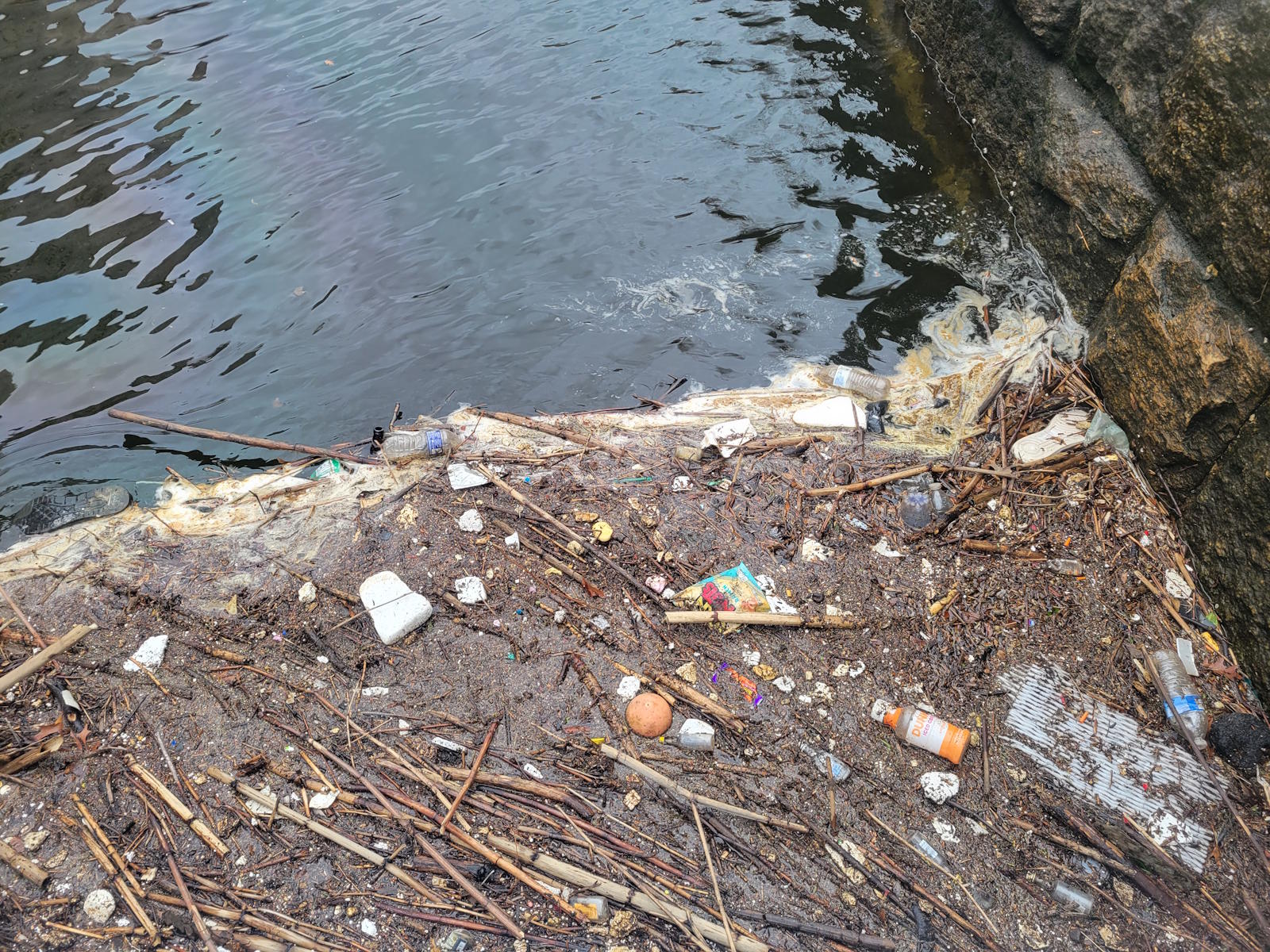
The first photograph is the bank: plastic bottles, packaging, dead reeds, accumulated waste pressed against rock by the current. Everything the river has received and cannot release. The system is like this too—it accumulates what it is given, presses it against hard surfaces, holds it. It does not sort what is valuable from what is not. It does not ask whether what it holds deserves to be held. It simply retains.
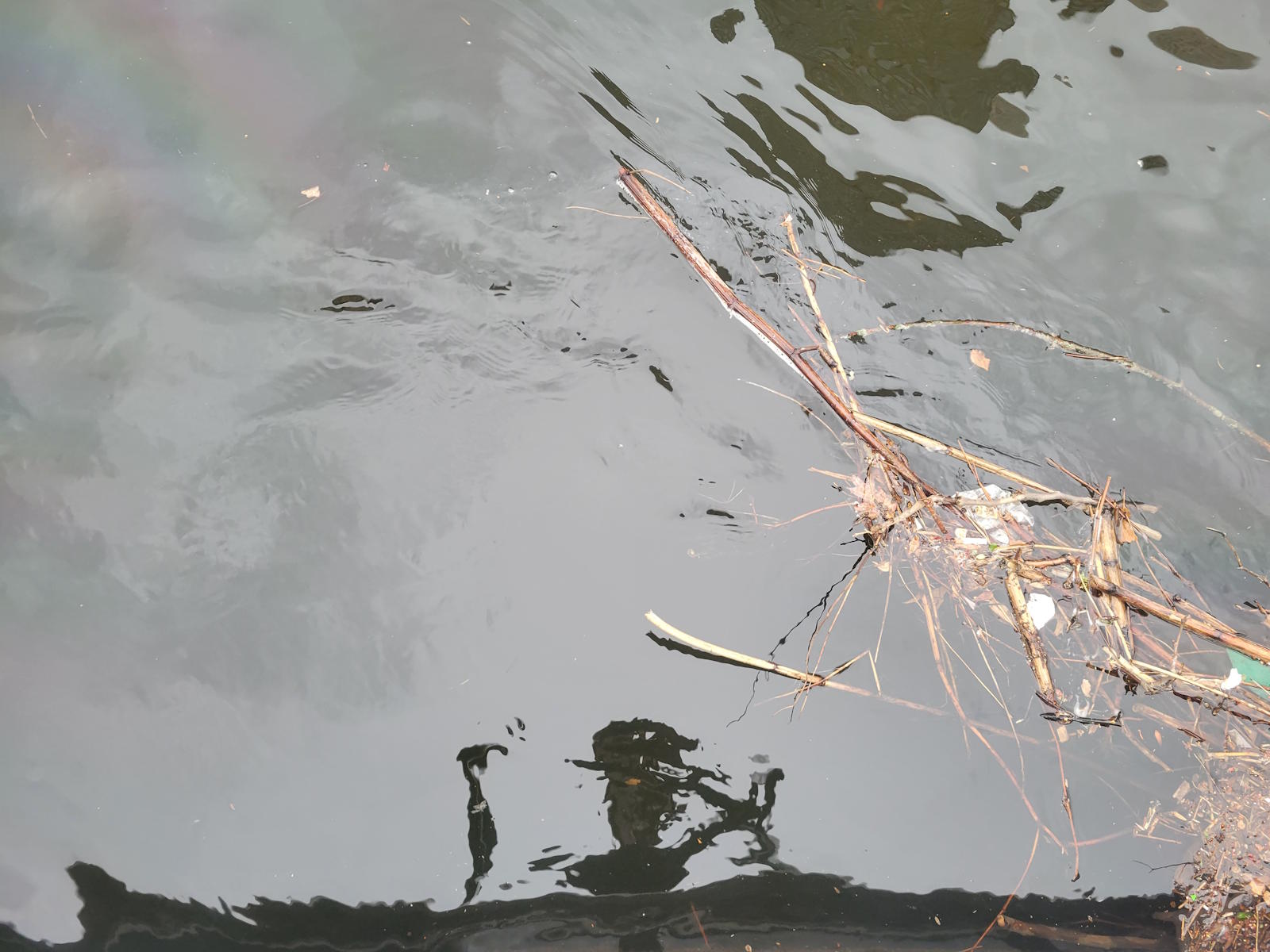
The second photograph is my shadow in the water among dead reeds. Not my reflection—just my shadow. Darker than the water. Less defined than it was in October, or perhaps I see it more clearly now: a shape, a dark outline, the minimum evidence that a person is standing here.
Look at the upper left of the frame. There is a rainbow on the water’s surface. An oil-slick rainbow—iridescent, improbable, beautiful in the way that things are sometimes beautiful when they have no right to be. A rainbow in polluted water. On my last day at this river. Three days before I board a flight home on a travel permit for a conviction that may never have been a crime.
In the first chapter, I asked water to remember me. It couldn’t. It held my reflection for a moment and let it dissolve. The oak leaves drifted past and were gone. I am still here.
The water below couldn’t hold me in October 2025. The system brought me back to stand above it again in March 2026. The water still cannot hold me. But it shows me, faithfully, what has accumulated here: the waste, the dead reeds, the dark shape of a person who has been waiting for months, and—impossibly, stubbornly—a rainbow.
I did not plan the rainbow. I did not seek it out. I was photographing because it was the only thing I had left to do.
I choose, one more time, to make art.
Bradley Airport, Gate — March 30, 2026
In October 2025, I photographed my shadow reaching toward the other bank of the Moshassuck River. The word I wrote beneath that image was: Temporary.
I did not know how right I was.
A blizzard. Two stabbings. A woman trying to set Kennedy Plaza on fire. A Superior Court ruling issued the morning I arrived telling me that what I was convicted of was never a crime. Forty-five days of the same streets, the same shelter system, the same wait—for that. All of it for that.
This photograph—taken before I board a flight to Pittsburgh—is not a triumphant answer to that word. The appeal is still pending. The system is unchanged. The Rhode Island Supreme Court has not yet ruled. I may be back. I do not know.
What I know is this: I have a flight. I have a travel permit. I have a husband at home who has been alone again, this time since February 12th. I have a house I have not been in for forty-five days. Today, I am going home.
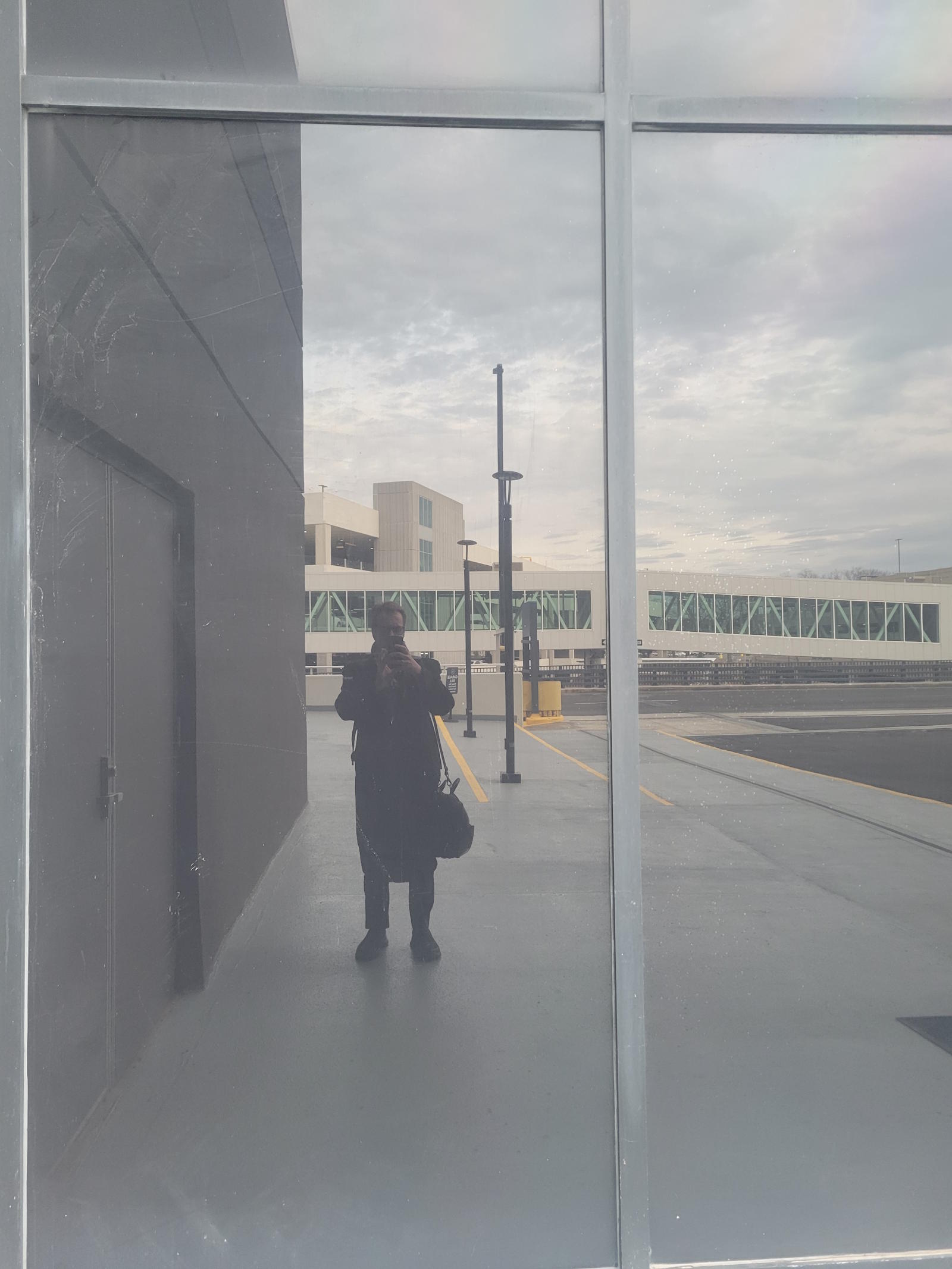
For six months I have photographed myself in water. Water holds nothing—it receives your image, distorts it, and releases it. That is its nature and, in this project, its gift: no memory, no judgment, only what stands before it now.
This final image is not water. It is glass. An airport terminal window, the tarmac behind it, a gray March sky. My reflection stands in the frame—dark, present, holding the camera, bag on my shoulder. Glass does what water does: it holds your image and shows you the world behind it simultaneously. You see yourself and where you are going at the same moment.
The system did not give me this. It delayed it, violated its own rules to prevent it, and still has not formally resolved anything. I am going home despite the system, once again on a temporary travel permit from the one person in this process who chose to see me as a human being.
Water remembers nothing. It shows you only what stands before it, in this moment, without record of what came before. What stands before it now is someone leaving. Someone going home.
For now. With everything still unresolved. For now.
Home. For now.
What Water Remembers — Still
February 12 – March 30, 2026
A blizzard. A ruling. A rainbow in polluted water. The same city. The same wait.
The system still has not been held accountable.
Technical Note
All photographs in What Water Remembers were taken on a cell phone provided by Better Lives RI, a Providence-based organization serving people experiencing homelessness. Each night during both ordeals documented here, I found shelter through Open Doors RI, a support and advocacy organization for the justice-involved and the homeless of Rhode Island.
When the state abandons you—when bureaucracy traps you in homelessness for weeks instead of the mandated five days—community organizations step in to preserve what the system destroys: dignity, safety, the ability to create. Better Lives RI gave me the tool to document my erasure. Open Doors RI gave me a place to sleep while enduring it.
Even the phone recording my erasure isn’t mine. But it allowed me to see, to document, to create evidence that I exist beyond what the system remembers about me. Together, these organizations allowed me to survive, to create, to insist I still matter.
The Chapter Two photographs from February 24, 2026 were taken during and after the historic blizzard that shut down Providence while the artist was homeless and unable to reach shelter. Pennsylvania still had not responded. The blizzard did not pause the clock. The final river photographs were taken on March 27, 2026—three days before the artist boarded a flight home.